![Native[risk]](http://images.squarespace-cdn.com/content/v1/65704856a75e450a6d17d647/f3aa0ca7-8a4d-4034-992f-9ae514f1127e/Native+risk_logo-invert.png?format=1500w)
#84 - The AI hangover no one's preparing for
A couple of weeks ago I wrote about how AI is going to fix fraud's biggest bottleneck - the reaction cycle. The post got solid traction, but one Linkedin comment was worth a re-read.
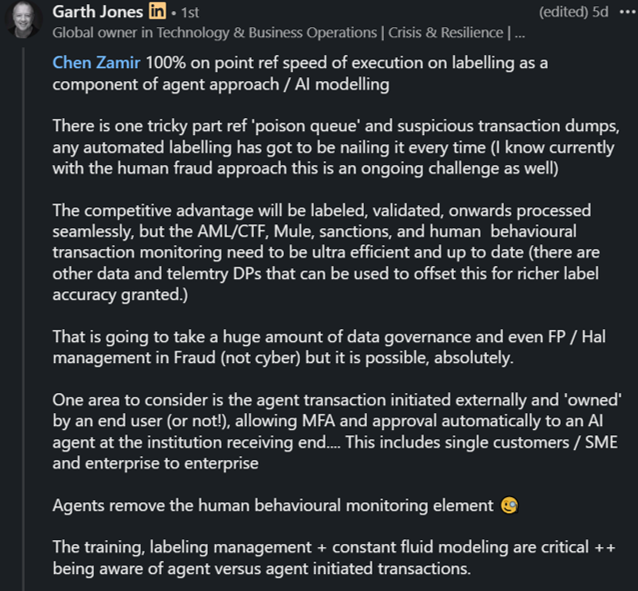
Garth raised the question of governance. And the more I sat with it, the more I realized I'd buried the real punchline.
So this week I want to address the part I didn't say out loud:
First, why machine speed changes the nature of the governance problem entirely.
Second, which function actually needs to grow to accommodate it - and why most teams are either ignoring it or massively underestimating it.
Why am I so excited about agentic AI?
Right now, most fraud teams are somewhere in early adoption.
Agentic investigations are slowly taking over the assembly work - enrichment, data gathering, and alert clustering.
But AI adoption isn’t going to end there. Because once we look outside of the fraud ops domain, there’s plenty AI can do on top. For example:
Population segmentation
Data quality and model drift monitoring
These are just the tip of the iceberg - the iceberg being all the manual processes we routinely run in a fraud prevention org.
But here's what I think most people miss - like ML at the time, the industry expects AI to be a turn-key, magical solution that would just work once implemented.
And like with ML at the time, AI would prove to be different in reality than the fantasies we’re being sold today.
What changes when the system runs at machine speed?
At human speed, managing control is easy:
An investigator flags a suspicious label
A manager notices a rule behaving strangely
Someone catches drift in a weekly review
The system is slow enough that humans can observe what's happening and course-correct before damages accumulate or even manifest.
But at machine speed, things break much faster than our ability to keep them in check:
An agentic labeling pipeline running continuously doesn't raise its hand when it starts misclassifying
A rule proposal engine doesn't flag when a backtest is built on a coincidental correlation rather than a genuine signal
A case clustering algorithm doesn't alert you when the rings it's assembling are starting to fall apart
These systems fail silently, they fail at scale, and they fail fast.
Because unlike humans, a machine doesn’t notice when things go wrong unexpectedly - It just keeps going. And the faster it goes, the more damage compounds before anyone catches it.
And this is just the beginning
Today, most teams need to manage only one automated process - event scoring and rule execution.
But with agentic AI taking over more tasks and automating them, the amount of automated pipelines would dramatically increase.
And so would the complexity of managing them:
In agentic labeling - who owns the error rate thresholds?
In rule proposals - who catches a rule that's statistically valid but commercially disastrous?
In case clustering - who audits whether the agent is incorrectly clustering rings due to a data quality issue?
Investigation resolution - who monitors for systematic bias in how cases are being resolved at scale?
Naturally, the term “AI Governance” comes to mind. But what does it actually mean?
Does governance equal having a “human-in-the-loop”? Are we expecting every decision to be approved by a human?
I hope not.
Instead, what governance really means is management. Exactly as we manage human teams today.
A well-run team has KPIs. It has monitoring capabilities that let it know it’s running in the right direction. It has alerts that notify it when something is wrong.
Running a bunch of AI agents is no different.
This means that governance isn’t only about HitL flows (although those are needed sometimes exactly for the same reason we still occasionally need managerial approval.)
It also means clear KPIs, live monitoring and alerting, periodic reviews, and most of all - constant adjustment of protocols and processes.
Who's watching the watchers?
Here's the thing: all of that oversight work lands on one function. And most fraud teams don't have nearly enough of it.
Fraud Analytics.
Right now, this function is in charge of reporting, performance monitoring, and rule writing. In most organizations it's small, sometimes informal, sometimes absorbed into senior investigators or data science.
In an agentic world, Fraud Analytics becomes the owner of the entire learning cycle.
Not just compiling reports or writing rules - but setting the quality standards for all automated pipelines and monitoring them.
But while we constantly talk about the headcount implications of AI being workforce reduction in ops, we rarely consider the fact we’ll actually require additional warm bodies to manage it.
Bottom line
Agentic AI is going to change the makeup of fraud organizations.
With agents maturing rapidly and organizations gaining trust, we’ll soon start seeing operational teams impacted.
That wouldn’t necessarily look like mass layoffs, but more likely a hiring freeze in spite of growing numbers of fraud cases.
What most fraud leaders fail to see is that in the medium term the demand for fraud analytics is going to rise sharply.
At least that’ll be the case if you want to run a modern fraud team.
And some would argue it was always the case…
If you’re planning on massive AI investments in the coming 12 months and you’re not considering this point, you are in for a rude awakening.
Are you running agents in your organizations? How are you managing them? Hit reply - I genuinely want to know where most teams are on this.
In the meantime, that’s all for this week.
See you next Saturday.
P.S. If you feel like you're running out of time and need some expert advice with getting your fraud strategy on track, here's how I can help you:
Free Discovery Call - Unsure where to start or have a specific need? Schedule a 15-min call with me to assess if and how I can be of value.
Schedule a Discovery Call Now »
Consultation Call - Need expert advice on fraud? Meet with me for a 1-hour consultation call to gain the clarity you need. Guaranteed.
Book a Consultation Call Now »
Fraud Strategy Action Plan - Is your Fintech struggling with balancing fraud prevention and growth? Are you thinking about adding new fraud vendors or even offering your own fraud product? Sign up for this 2-week program to get your tailored, high-ROI fraud strategy action plan so that you know exactly what to do next.
Sign-up Now »
Enjoyed this and want to read more? Sign up to my newsletter to get fresh, practical insights weekly!