![Native[risk]](http://images.squarespace-cdn.com/content/v1/65704856a75e450a6d17d647/f3aa0ca7-8a4d-4034-992f-9ae514f1127e/Native+risk_logo-invert.png?format=1500w)
#68 - Fraud is good for business
I was going through LexisNexis’ recent “True Cost of Fraud” study and, as expected, it was pretty boring - the same old “insights” from previous years.
But then it hit me:
Fraud is the best thing that can happen to your business.
Yes, it surprised me as well at first. But after giving it some thought, I found myself asking “why is it surprising? It makes perfect sense.”
Alright, let me backtrack and present my argument.
The automation selection bias
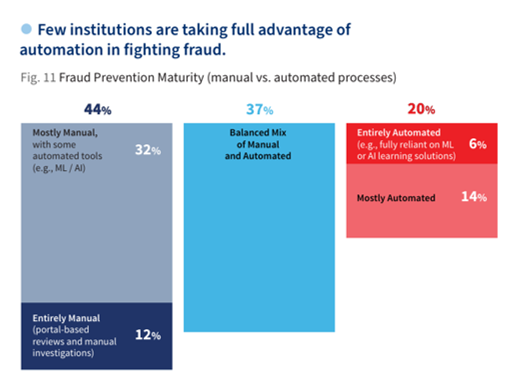
We start with the obvious: most financial institutions are still fighting fraud manually.
The LexisNexis report shows only 20% of North American FIs use primarily automated fraud strategies today.
But here's where it gets interesting:
These automated organizations don't just happen to be more tech-forward. They're facing 36% more fraud pressure than their manual counterparts.
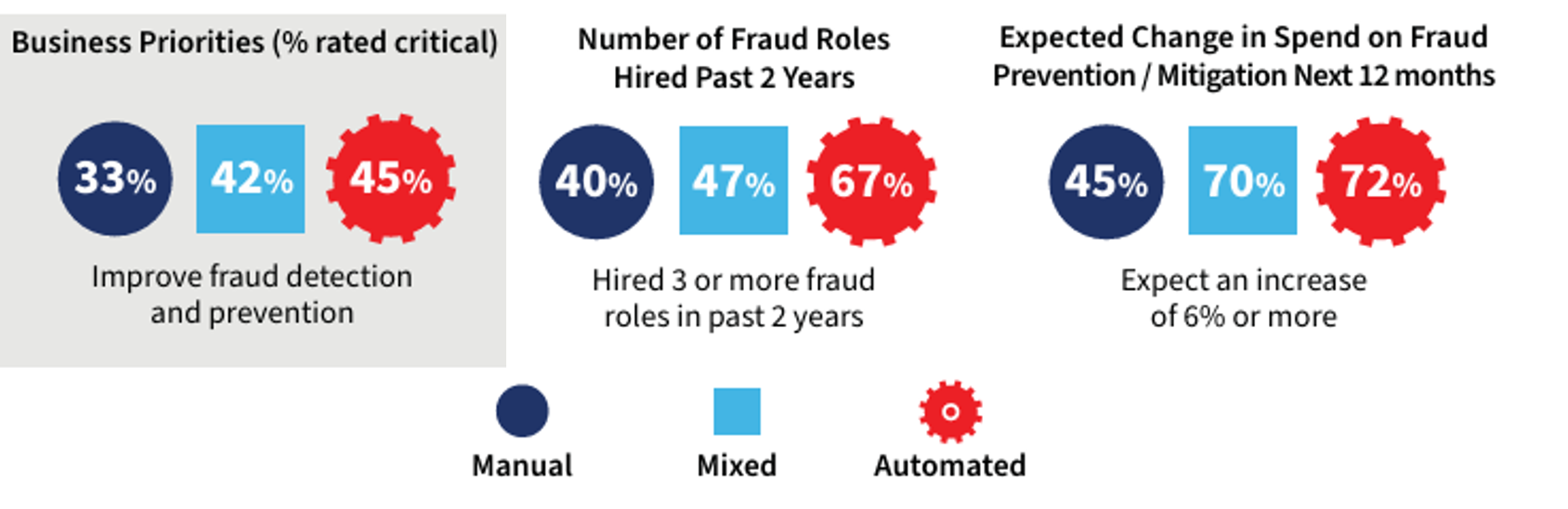
Look at the numbers: 45% of automated institutions rate fraud as "critical" versus only 33% of manual ones.
They're also staffing up like crazy. 67% of automated businesses hired three or more fraud roles in the past two years, compared to just 40% of manual organizations.
And their budgets? 72% of automated institutions expect to increase fraud spending by 6% or more, versus only 45% of manual ones.
The pattern is clear: organizations automate in response to fraud pressure, not as some universal best practice they read about in a whitepaper.
More fraud equals bigger operations and higher budgets, which in turn create bigger efficiency gains from automation.
It's selection bias hiding in plain sight.
The performance gap
So what happens when you're forced to automate because fraud is beating down your door?
Unsurprisingly, automated organizations rate their effectiveness higher: 95% say their efforts are "extremely or mostly effective" versus 84% for manual teams.
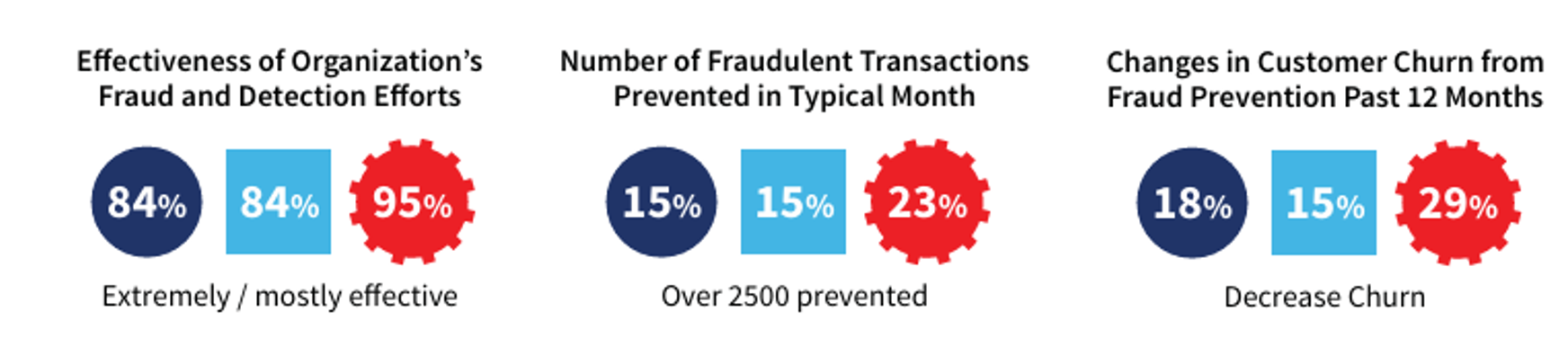
They're also stopping more fraud. 23% prevent over 2,500 fraudulent transactions monthly, compared to just 15% of manual organizations.
But here's the metric that I find most curious:
Automated organizations reduce customer churn 61% more often than manual ones - 29% saw decreased churn versus only 18% of manual organizations.
Think about that for a second.
The teams under the most pressure, fighting the most fraud, are also the ones protecting the customer experience better.
That last figure was what stopped me and got me thinking.
Here's what the report doesn't say explicitly:
Automation doesn't just speed up fraud detection. It speeds up everything.
When you automate fraud prevention, you're also automating onboarding, dispute resolution, transaction approvals - every process that touches the customer.
And that's why automated organizations see 61% better churn reduction.
It's not because they're being clever about fraud. It's because automation forced by fraud pressure creates faster, smoother experiences across the board.
And here’s the thing: everyone agrees friction matters - in the study, 93% of all institutions say they prioritize reducing it.
But only teams facing serious fraud pressure have the ability to actually solve it.
What this means for your strategy
I didn’t find any new, exciting insights from LexisNexis’ study. The results look pretty similar every year, even after two years of an AI “revolution”.
But it did click something into place for me: the real insight isn't that automation is good for fraud prevention.
We already knew that.
The real insight is that fraud pressure acts as a forcing function - one that drives organizations to build better customer experiences than they would have otherwise.
Teams that don't face serious challenges lack both the motivation and the resources to compete at the top level.
The sad truth is that they can afford to be mediocre. They can afford slow, manual processes. They can afford to add friction without thinking twice.
Until they can't.
So if you're facing increased fraud pressure right now, here's the reframe:
You're not behind. You're being pushed to get better faster than your competitors.
The question isn't whether to invest in automation.
It's whether you'll use this pressure to build something that compounds - better fraud detection and better customer experience.
Or to put it in different words, whether fraud is a cost center or whether it evolves into a profit center.
The organizations that figure this out don't just stop more fraud.
They win the market.
Have you seen this pattern in your own organization? Hit reply and let me know what forcing functions have driven your best improvements.
In the meantime, that’s all for this week.
See you next Saturday.
P.S. If you feel like you're running out of time and need some expert advice with getting your fraud strategy on track, here's how I can help you:
Free Discovery Call - Unsure where to start or have a specific need? Schedule a 15-min call with me to assess if and how I can be of value.
Schedule a Discovery Call Now »
Consultation Call - Need expert advice on fraud? Meet with me for a 1-hour consultation call to gain the clarity you need. Guaranteed.
Book a Consultation Call Now »
Fraud Strategy Action Plan - Is your Fintech struggling with balancing fraud prevention and growth? Are you thinking about adding new fraud vendors or even offering your own fraud product? Sign up for this 2-week program to get your tailored, high-ROI fraud strategy action plan so that you know exactly what to do next.
Sign-up Now »
Enjoyed this and want to read more? Sign up to my newsletter to get fresh, practical insights weekly!